
Evolution of the Sun’s Alfvén surface with solar activity
This is a PUNCH Science Nugget
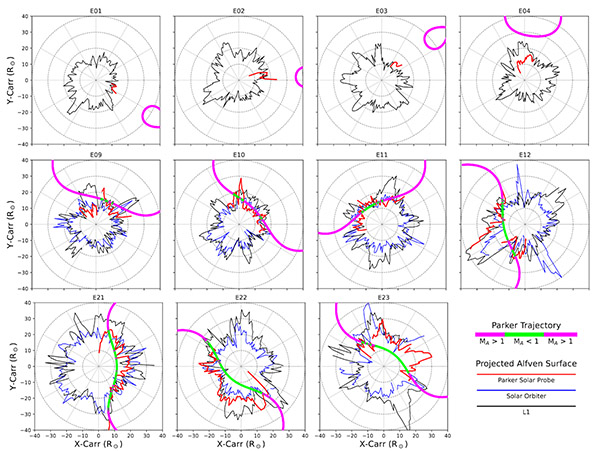
The Alfvén Zone that PUNCH will image is the region that Parker Solar Probe (PSP) flies through. Each panel above shows the shape of the Alfvén surface in the Sun’s equatorial plane during a particular PSP encounter (E), ranging from E01 (November 2018, a period of minimum solar activity) to E23 (April 2025, near maximum activity). Red, blue, and black lines indicate the Alfvén surface obtained from analyses of data from various spacecraft. The thick curve shows the Parker trajectory (green when under the Alfvén surface) in the frame co-rotating with the Sun. Concentric circles mark reference distances from the Sun, at 10, 20, 30, and 40 solar radii. Figure from Badman et al. (2025).
Heliophysicists have produced the first continuous, two-dimensional maps of the Sun’s Alfvén surface – the region of space where the solar wind irrevocably escapes the grip of the Sun’s magnetic field – and demonstrated the dynamical variation of its properties as our star moves through its activity cycle. Beyond this boundary, the speed of outflowing solar material becomes faster than the speed of magnetic waves, marking an effective outer “edge” of the solar atmosphere. Published in The Astrophysical Journal Letters (Badman et al. 2025) and co-authored by PUNCH Co-I Rohit Chhiber, the study employed a combination of in-situ measurements and magnetic models from several space missions spanning a range of distances from the Sun, to infer the location of the Alfvén surface in the Sun’s equatorial plane, thereby providing a “top-down” view (looking downwards from above the solar system) of its probable shape. Tracking the surface’s evolution from 2018 (when the Sun was dormant) to 2025 (when it was highly active) revealed that its distance from the Sun, its thickness, and its “spikiness” increased with solar activity.
The above perspective of the Alfvén surface will be greatly enhanced by maps generated from PUNCH observations, which provide a “side” view of the Sun and the inner solar system with a cadence of hours rather than months. PUNCH uses a feature-tracking technique to measure Alfvén surface location directly using remote sensing; by contrast, Parker Solar Probe samples the Alfvén surface directly but only where the Probe orbit intersects it, and other measurements use extrapolation, modeling, and inference to estimate the shape. Together, these studies will help scientists better understand the physical processes occurring in near-Sun space, which can, in turn, benefit the development of solar wind and space weather models that provide more accurate forecasts of how solar activity shapes the environment around Earth and other planets. Improved knowledge of the Sun’s Alfvén surface will also help astrophysicists answer wide-ranging questions about the lives of other stars and their influence on the habitability of planets.
PUNCH science nuggets are archived on our News Page.
You can subscribe to PUNCH nuggets by email.
NASA official releases about PUNCH are at the NASA PUNCH blog.