
Visualizing Artemis-Mission CMEs with PUNCH
This is a PUNCH Science Nugget
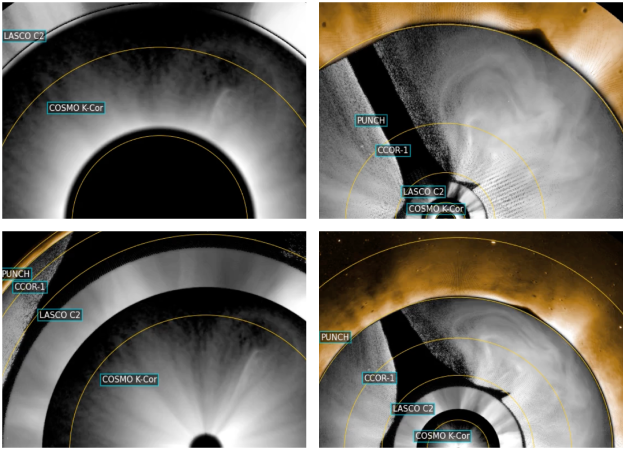
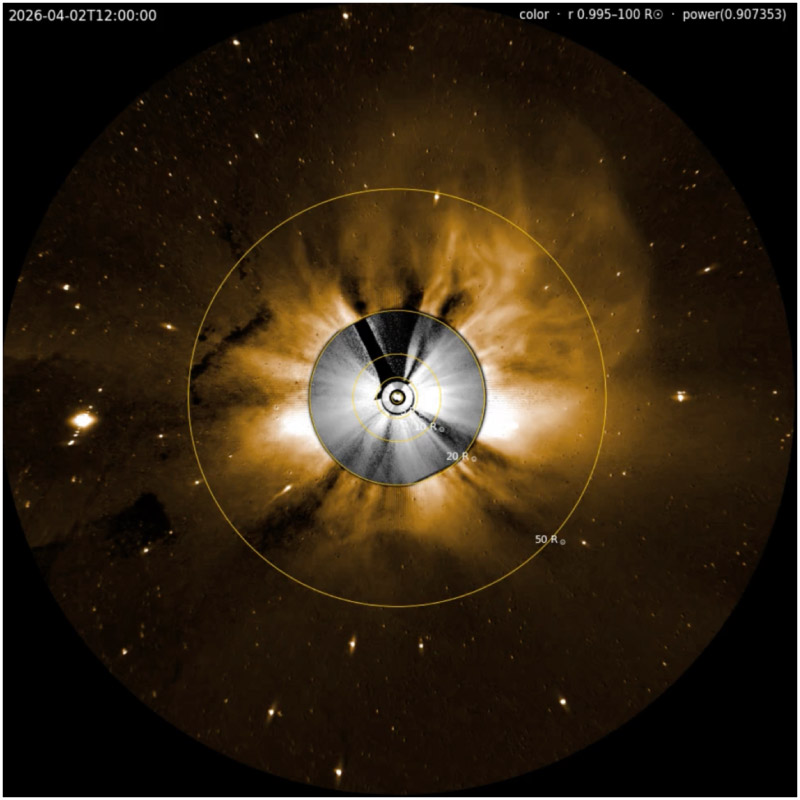
The coronal mass ejection (CME) of April 1-2 2026 started fast and low in the corona (left column: 2026-04-01 23:10 UT), blasting its way out through the solar wind (middle column: 2026-04-02 02:00 UT) to a distance more than halfway to Earth's orbit as viewed by the PUNCH spacecraft (right: 2026-04-02 12:00 UT). The images in the upper-left panels show this progress by zooming out linearly, while the lower-left panels employ a new visualization tool, built upon the JHelioviewer framework, which applies a time-varying power-law radial stretch to emphasize where the CME is centered in the nested coronal and heliospheric images, thus illustrating connections from CME origins at the Sun and evolution throughout the global view of PUNCH. (MOVIES: top, bottom)
The coronal mass ejection (CME) of April 1-2 2026 started fast and low in the corona (top, left column: 2026-04-01 23:10 UT), blasting its way out through the solar wind (top, right column: 2026-04-02 02:00 UT) to a distance more than halfway to Earth's orbit as viewed by the PUNCH spacecraft (bottom: 2026-04-02 12:00 UT). The images in the top, upper panels show this progress by zooming out linearly, while the top, lower panels employ a new visualization tool, built upon the JHelioviewer framework, which applies a time-varying power-law radial stretch to emphasize where the CME is centered in the nested coronal and heliospheric images, thus illustrating connections from CME origins at the Sun and evolution throughout the global view of PUNCH. Movies: top, bottom
With PUNCH's gigantic field of view (90 degrees across!) we can now visually track solar storms as they move through the solar wind. Using that huge field of view requires new visualization tools. The images and linked movies above show a "halo" (Earth-directed) coronal mass ejection (CME) that produced a modest radiation storm mere hours after the Artemis II astronauts were launched from Kennedy Space Flight Center on their historic trip to return to the Moon. The left column of the four-image panel shows the fast-moving CME (850 km/sec, accelerating at 414 m/s^2) caught close to the Sun by the NSF/NCAR Mauna Loa Solar Observatory (MLSO) K-Coronagraph (K-Cor), the right column of the four-image panel shows the CME stretching across the fields of view of K-Cor, the NASA/SOHO/LASCO and NOAA/GOES/CCOR-1, and PUNCH, and the single, larger image shows the CME still moving across the PUNCH field of view in an extreme zoom-out from the Sun about thirteen hours after Artemis II launched at 22:35 UT on April 1, 2026. Solar radiation was closely monitored throughout the Artemis mission in order to warn astronauts to seek protection in case a large solar energetic proton (SEP) event occurred. Fortunately the SEP event associated with this CME was modest, falling just short of a S1 level radiation storm. Since SEPs can be accelerated throughout a CME's passage through the solar wind, PUNCH's global view may well prove critical for space weather situational awareness. Further observations and analysis of this event can be found at the MLSO Gallery page.
PUNCH science nuggets are archived on our News Page.
You can subscribe to PUNCH nuggets by email.
NASA official releases about PUNCH are at the NASA PUNCH blog.