
The Wide Field Imager (WFI) for PUNCH
This is a PUNCH Science Nugget
This article is based on the sixth paper in the collection PUNCH Mission: An Overview – A Topical Issue of Solar Physics.
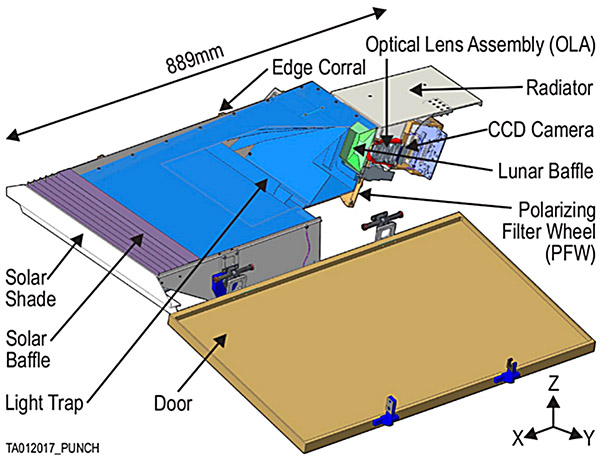
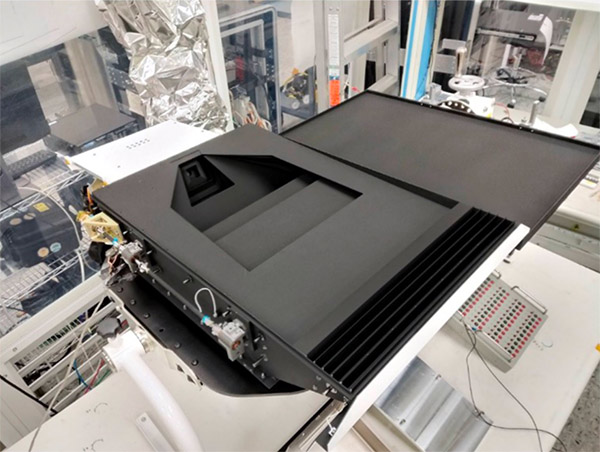
Three Wide-Field Imagers capture most of the inner solar system for PUNCH. Left (or top, if stacked): compact design shows a polarizing wide-field camera attached to a large three-part baffle; Right (or bottom, if stacked): WFI-1 was tested and aligned in a clean-room facility at SwRI before launch.
The Wide Field Imagers (WFIs) are the heliospheric imagers for NASA’s PUNCH mission. Three of them together image nearly the entire inner solar system in a single merged field of view. The WFIs were developed at Southwest Research Institute (SwRI) in Boulder, CO, and integrated with the PUNCH Spacecraft in San Antonio, TX, before launching on March 11th, 2025.
The key component of the WFI instrument is the deep, multi-staged Baffle that is designed to suppress sources of stray light into the system, including Fresnel diffraction, earthshine, and moonlight. When coupled with the WFI internal optics, the Baffle attenuates stray light by over 16 orders of magnitude, revealing extremely faint moving structures and inhomogeneities in the outer corona and inner heliosphere. In conjunction with a filter wheel and imaging camera at the rear of the instrument, WFI views polarized sunlight that has been Thomson-scattered by free electrons, over a nearly 45° wide field of view. This FOV extends from under 3.5° to over 47° from the Sun. In orbit, the 3 WFI instruments are arranged 120° apart in position angle such that their collective fields-of-view form an approximately symmetric trefoil on the sky, providing polarized images of the solar wind over an unprecedented 90° wide, full circle field of view centered on the Sun.
The three WFI instruments work in concert with the PUNCH Narrow Field Imager (NFI) to create a unified, global view of the solar wind's transition from the corona to the heliosphere. Together with a sophisticated ground-processing software pipeline, the combined observatory now provides continuous data products revealing the electron density structure of the entire inner heliosphere. The WFI overview paper describes the details of the design and end-to-end calibration performance of the instruments and how they contribute to the PUNCH mission’s goal of understanding the corona and heliosphere as a single unified system.
PUNCH science nuggets are archived on our News Page.
You can subscribe to PUNCH nuggets by email.
NASA official releases about PUNCH are at the NASA PUNCH blog.