
Tracking CMEs Across the Solar System
This is a PUNCH Science Nugget
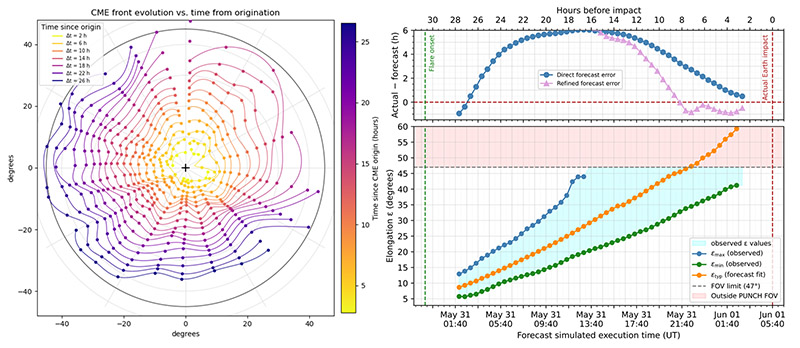
PUNCH routinely views halo CMEs out to over 45° from the Sun. This yields evolving maps of the shape of the CME "front" (left). Fitting a very simplified three-parameter model to the CME at left yielded a very high precision (30 minute error) forecast of the arrival time, eight hours before arrival, in a simulated forecast activity.
Forecasting space weather events is difficult, because space weather originates at the Sun, and most instruments only view near the Sun. Forecasting the arrival of a strong CME at the Earth requires extrapolating the behavior of the CME from the first 10% of its trajectory (in the corona), all the way across the inner solar system. PUNCH tracks Earth-directed CMEs across 45° or more of sky, following them for 80% of their trajectory instead of just the very beginning.
We first make "difference images" by subtracting a previous image from each time step, minimizing background elements such as stars, and enhancing outward motions, such as CME fronts.
The left figure shows the evolving front of a CME seen by PUNCH at the very start of the mission, during commissioning in late May of 2025. We used those front data to fit a very simple geometric model (the Ludicrous Ice-Cream Cone (LICC) model, which has just three parameters: position angle, off-axis angle, and fixed speed), and to extrapolate the model to estimate the arrival time at Earth. Each blue dot in the upper-right plot represents a simulated forecast, made by fitting the LICC model to current PUNCH data up to the corresponding time. At first, the forecasted arrival times are about 6 hours early, but as the CME progresses, they settle down gradually to the actual arrival time of 5am on 1-June.
Using the time series, we used linear extrapolation to estimate when the forecasted time would intersect "real" (simulated) time. That forecast-of-forecasts (lavender triangles) yielded a stable prediction that was just 30 minutes off from the actual measured arrival time 2025 June 2 just after 5:00 am. Conventional forecasts, coordinated by NASA's Community Coordinated Modeling Center, had a more typical spread of ±5 hours.
This result was reported at the 2026 COSPAR meeting and is currently undergoing peer review in the journal Space Weather. It is also the subject of a SwRI press release.
PUNCH science nuggets are archived on our News Page.
You can subscribe to PUNCH nuggets by email.
NASA official releases about PUNCH are at the NASA PUNCH blog.