
The Narrow Field Imager (NFI) for PUNCH
This is a PUNCH Science Nugget
This article is based on the fifth paper in the collection PUNCH Mission: An Overview – A Topical Issue of Solar Physics.
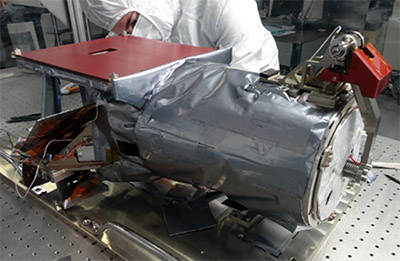
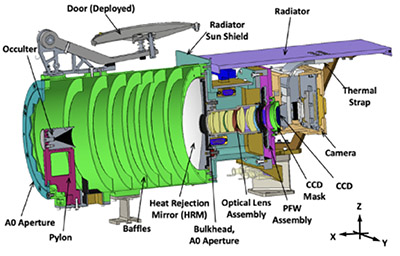
The Narrow Field Imager (NFI), the coronagraph for NASA's PUNCH mission, images the innermost part of the PUNCH field of view. It was delivered about eight months before launch, and successfully met all pre-launch requirements in testing. NFI is an example of a new class of “compact” coronagraphs developed at the Naval Research Laboratory, with a single stage of external occultation to observe the faint solar corona with a small form factor.
A key element is the stray-light suppression assembly (SSA), which works in concert with the precision-engineered occulter and a series of internal baffles to reject unwanted light. This allows the instrument's large-aperture lens system and polarization optics to resolve the polarized light of the outer corona and inner heliosphere. The front of the SSA is exposed to the “eternal noontime” of space, and in just a few inches reduces the bright solar glare by a factor of over one billion – 10x darker than the new Moon. The instrument's CCD imaging system then captures the remaining light, enabling NFI to produce continuous, high-resolution images of the fine-scale structures where the solar wind originates in the outer corona.
By imaging this critical, under-observed region, NFI works in concert with the PUNCH Wide Field Imagers (WFIs) to create a unified, global view of the solar wind's transition from the corona to the heliosphere. The suite enables scientists to track the evolution of space weather events from outer corona continuously across the inner solar system. The development of this complex instrument is a critical step toward achieving the PUNCH mission’s goal of understanding the corona and heliosphere as a single unified system.
PUNCH science nuggets are archived on our News Page.
You can subscribe to PUNCH nuggets by email.
NASA official releases about PUNCH are at the NASA PUNCH blog.