
Eclipse Season for PUNCH
This is a PUNCH Science Nugget
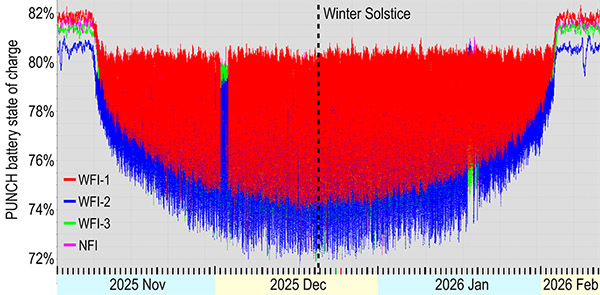
The “dark days” winter season of 2025 is reflected in the PUNCH battery state of charge, as each spacecraft passed through Earth’s shadow once per orbit.
Late November through late January is the darkest time of year in Earth’s northern hemisphere, as Earth’s axis points away from the Sun, making nights longer and days shorter. PUNCH experiences the seasons too: during these dark days, each spacecraft spends a few minutes per orbit passing through Earth’s shadow (and experiencing a brief “night”). This plot shows the state of charge of all four satellites’ batteries over the ten-week “eclipse season”, highlighting that even orbiting spacecraft experience the same astronomical calendar that we do.
Our orbit is deliberately canted 7° away from the poles: the spacecraft pass over the midnight line at 83° north longitude, every orbit, so at the equinoxes (about every March 21 and September 21) each spacecraft sees the Sun 7° below horizontal while flying over the Arctic. At the winter solstice, the Sun is a little over 23° south of the equator, a full 30° below horizontal for the spacecraft, and the Earth itself blocks the Sun. The WFIs continue collecting science data (Earth never enters their field of view), but NFI data are compromised during this time by the bright polar sunset/sunrise.
Since PUNCH is solar-powered, each spacecraft automatically switches to battery power for a few minutes as it passes through Earth’s shadow. By monitoring the state of charge of the batteries, we can see how “eclipse season” progressed. All four spacecraft used up to about 5% of their battery once per orbit (15 times per day), and recharged back up to the nominal 80% state-of-charge when they came back into the sunlight. By February 4, all four spacecraft were back in the sunlight full-time.
PUNCH science nuggets are archived on our News Page.
You can subscribe to PUNCH nuggets by email.
NASA official releases about PUNCH are at the NASA PUNCH blog.