
Polarimeter to Unify the Corona and Heliosphere (PUNCH)
This is a PUNCH Science Nugget
This article is based on the sixth paper in the collection PUNCH Mission: An Overview – A Topical Issue of Solar Physics.
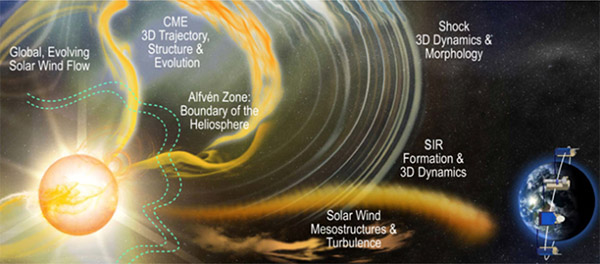
The PUNCH science and constellation structure are captured in this artist’s rendering from 2016. PUNCH is structured to address six science topics organized into two science objectives: the ambient solar wind (solar wind flow, Alfvén zone, and mesostructures & turbulence); and transient structures (coronal mass ejections, stream interaction regions, and shocks).
The Polarimeter to Unify the Corona and Heliosphere (PUNCH) is a complicated mission to do a very simple thing: image the entire outer corona and inner heliosphere, all the time, in 3D. This overview paper describes the entire design arc: the motivating science, the mission science requirements and their definition process, the mission design, the instrumentation, the data products and analysis tools, and at least some additional science enabled by PUNCH.
The complexity enabled PUNCH to work within the low-cost Small Explorer program: it turned out to be less expensive (and more resilient) to fly a constellation of near-identical smallsats in low Earth orbit than to fly one more sophisticated probe to deep space.
PUNCH data products are built to work as if they came from a single instrument, but they actually are mosaics of four images each, acquired by all the spacecraft. This requires careful planning and sequencing to keep the spacecraft both optically compatible and synchronized to within one second, despite being spread out literally around the globe. It also requires exquisite calibration and co-alignment work on the ground, at the level of 0.1% photometric precision and <0.1 pixel alignment across roughly twelve million pixels from four different spacecraft. The precision is important because the solar wind is extremely tenuous: at Mercury’s orbit, a third of the way from Sun to Earth, there are typically just 10-100 atoms per cubic centimeter, comparable to the very best vacuum chambers here on Earth. So the solar wind itself can be 1000x fainter than the Milky Way.
By merging all four fields of view, PUNCH allows “astrophysics at home”: its data are wide-field views of our local environment in space, not telescopic snapshots of impossibly distant stars and galaxies. The overview paper describes how and why this mission is making visible the nearly-invisible solar wind that washes over us daily.
PUNCH science nuggets are archived on our News Page.
You can subscribe to PUNCH nuggets by email.
NASA official releases about PUNCH are at the NASA PUNCH blog.