
Polarization Diagnostics Applied to Coronal Mass Ejections and the Background Solar Wind
This is a PUNCH Science Nugget
This article is based on the seventh paper in the collection PUNCH Mission: An Overview – A Topical Issue of Solar Physics.
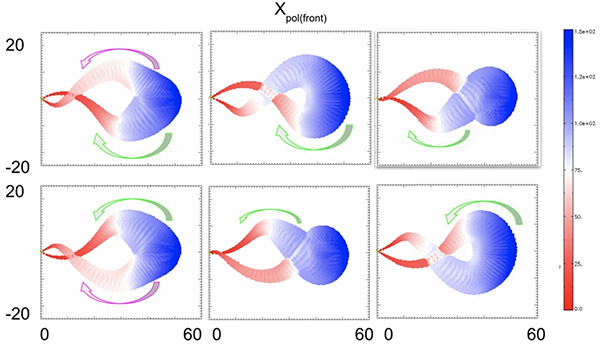
PUNCH polarization data trace out the 3D chirality of coronal mass ejections (CMEs) as they move through the heliosphere. Axes and color bars are in units of solar radii.
Polarization puts the "P" in PUNCH! The ratio of radially to tangentially polarized Thomson-scattered white light provides a powerful tool for locating the 3D position of compact structures in the solar corona and inner heliosphere, and PUNCH has been designed to take full advantage of this capability.
The figure shows three views on a "twisted croissant" model of a CME, with right-handed (top) and left-handed (bottom) chiral structure. The color indicates distance along the observer's line of sight as determined from synthesized PUNCH polarization data. The red-blue color table is centered on the position of the intersection of the CME trajectory and the line of sight, and the green curved arrows show circulation about an axis that establishes the flux rope chirality, or handedness. The pink arrow tracks an apparent circulation of the opposite sign, which however can be ruled out by mapping out the CME's full 3D structure.
Not all structures can be located simply this way. Extended density structures can cause confusion. In the extreme case of a structure as large as the whole corona, the degree of polarization actually becomes a measure of how rapidly density drops as the solar wind travels away from the Sun. So it's important to estimate whether a given structure is compact or extended along the line of sight, when analyzing its 3D location. In this PUNCH Topical Issue paper, we build from analyses of individual lines of sight to three-dimensional models of coronal mass ejections (CMEs) (such as the Twisted Croissant model shown in the figure), allowing us to consider how accurately polarization properties of the transient and quiescent solar wind are diagnosed. In this way, we demonstrate the challenges and opportunities presented by PUNCH polarization data for various quantitative diagnostics.
PUNCH science nuggets are archived on our News Page.
You can subscribe to PUNCH nuggets by email.
NASA official releases about PUNCH are at the NASA PUNCH blog.