PUNCH News & Nuggets

Mission Development articles | Outreach articles | Science articles | All articles (or Paginated)

2025-10-27

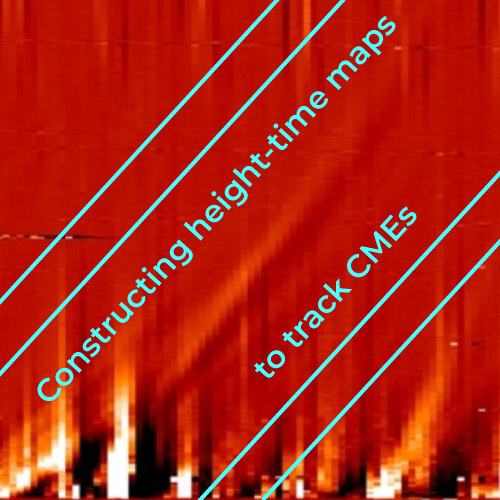
During this meeting, we will track a CME through PUNCH's field of view and connect it to other mission observations.


2025-10-09 PUNCH Science Nugget

PUNCH compresses its images on-orbit with “square-root coding”, to avoid downlinking photo-counting noise (Nugget #13 “Don’t Downlink Quantum Noise”). Removing the photon noise affects the statistics of remaining noise in the data, in a way that depends on the original data value. That, in turn, affects measurements of stray light in the instruments, putting a faint pattern of stripes in PUNCH photometric data (visible as the “stairstep” pattern in the blue trace in the top plot).


2025-09-19 PUNCH Science Nugget

Last week, astronomers announced a new comet, designated C/2025 R2 (SWAN), that was discovered in Lyman-α images from the SOHO spacecraft. Since mid-August, PUNCH has been observing this comet, along with every other object within 45° of the Sun. PUNCH collects data at a 4-minute cadence in polarized light and at an 8-minute cadence in unpolarized light.


2025-08-22 PUNCH Science Nugget

Energetic particles associated with shocks driven by fast coronal mass ejections (CMEs) or shocks developed by stream interaction regions (SIRs) often extend to high energies and are key elements of space weather. PUNCH is designed to track of solar wind structures through interplanetary space. Dayeh et al. (2025) reported a strong and robust relation between the shock speed jump magnitude at CME and SIR shocks, and the peak fluxes of energetic particles. Their analysis was based on 59 CME-driven shocks and 74 CIRs observed by Wind/STEP between 1997 – 2023. With that relationship, QuickPUNCH image sequences, and new methods for identifying speed jumps in the solar wind, we can forecast shock-associated particle events and their location in interplanetary space. PUNCH science data may become a crucial input to forecasting radiation events in the inner heliosphere.


2025-08-10

The AIAA Small Satellite conference nominated PUNCH as a finalist for its prestigious Smallsat Mission of the Year award!


2025-07-28 PUNCH Science Nugget

Scale-invariant 1/ƒ noise is a familiar observation across a wide array of natural and artificial systems, including heart rate fluctuations and loudness patterns in musical compositions. In the solar wind, it is seen mostly in the magnetic field energy spectrum across timescales from minutes to several days, where it represents fluctuations with equal power per frequency octave. First identified in the heliosphere in the 1980s, 1/ƒ noise has prompted ongoing discussion concerning its generation mechanism and place of origin – whether it forms locally in the solar wind or, as suggested by the long timescale of its influence, it stems from deeper solar processes linked to coronal dynamics and the solar dynamo. NASA’s PUNCH mission will capture high-resolution images of the inner solar wind and the corona, allowing studies of the spatial structures of the plasma that may be associated with the 1/ƒ observations1, with the potential to reveal the origin and evolution of these enigmatic heliospheric 1/ƒ signals. In preparation for these new observations, PhD student Victoria Wang (working with PUNCH Co-Investigator William Matthaeus) and colleagues have reviewed the current state of our understanding of in the heliosphere as our third featured paper from the Solar Physics PUNCH Mission Overview Topical Issue (J. Wang et al., Solar Physics, 2024, 299:169).


2025-07-24

Come Play in the PUNCH Sandbox! Get to know PUNCH data and have your questions answered by the experts.


Display all 63 stories